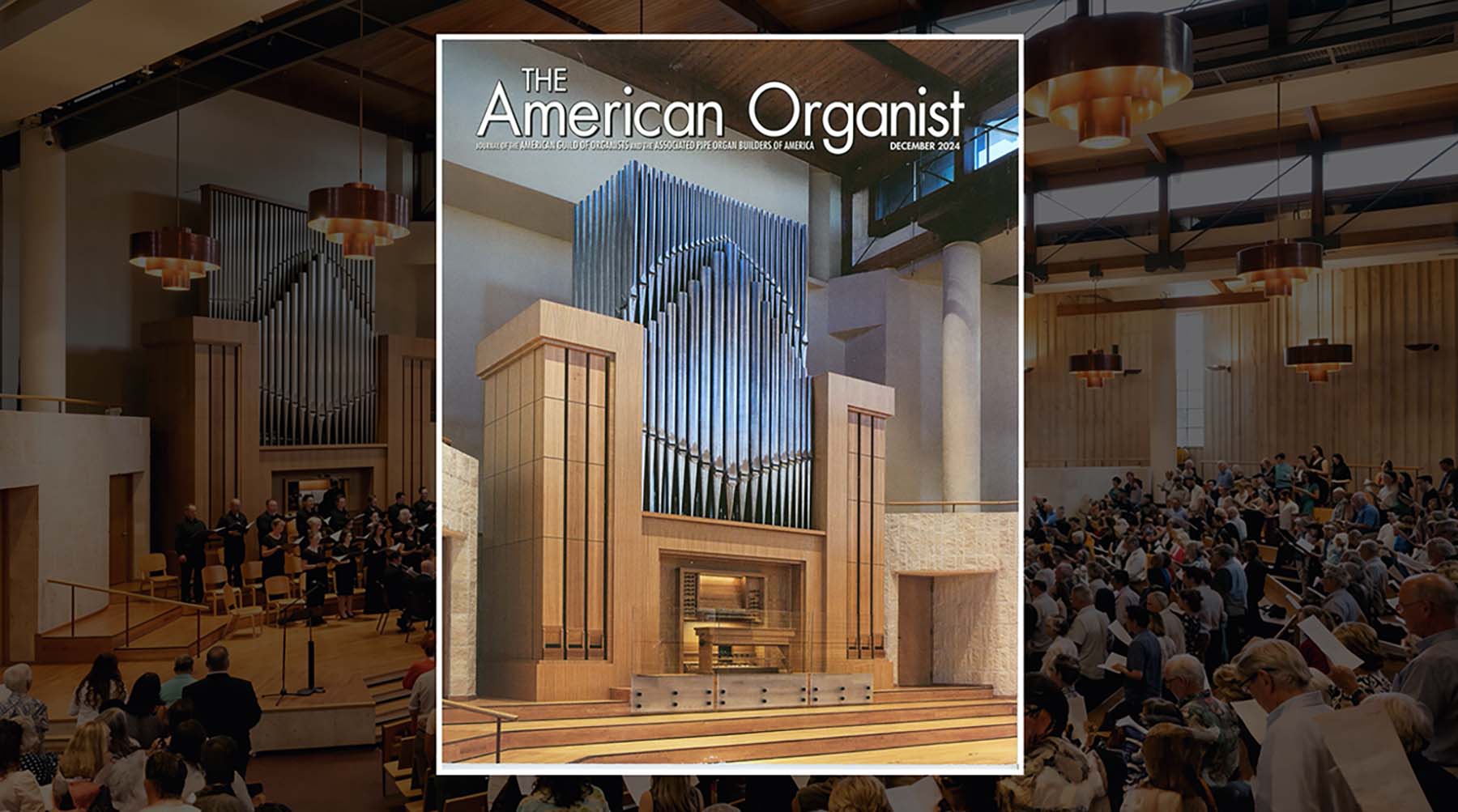
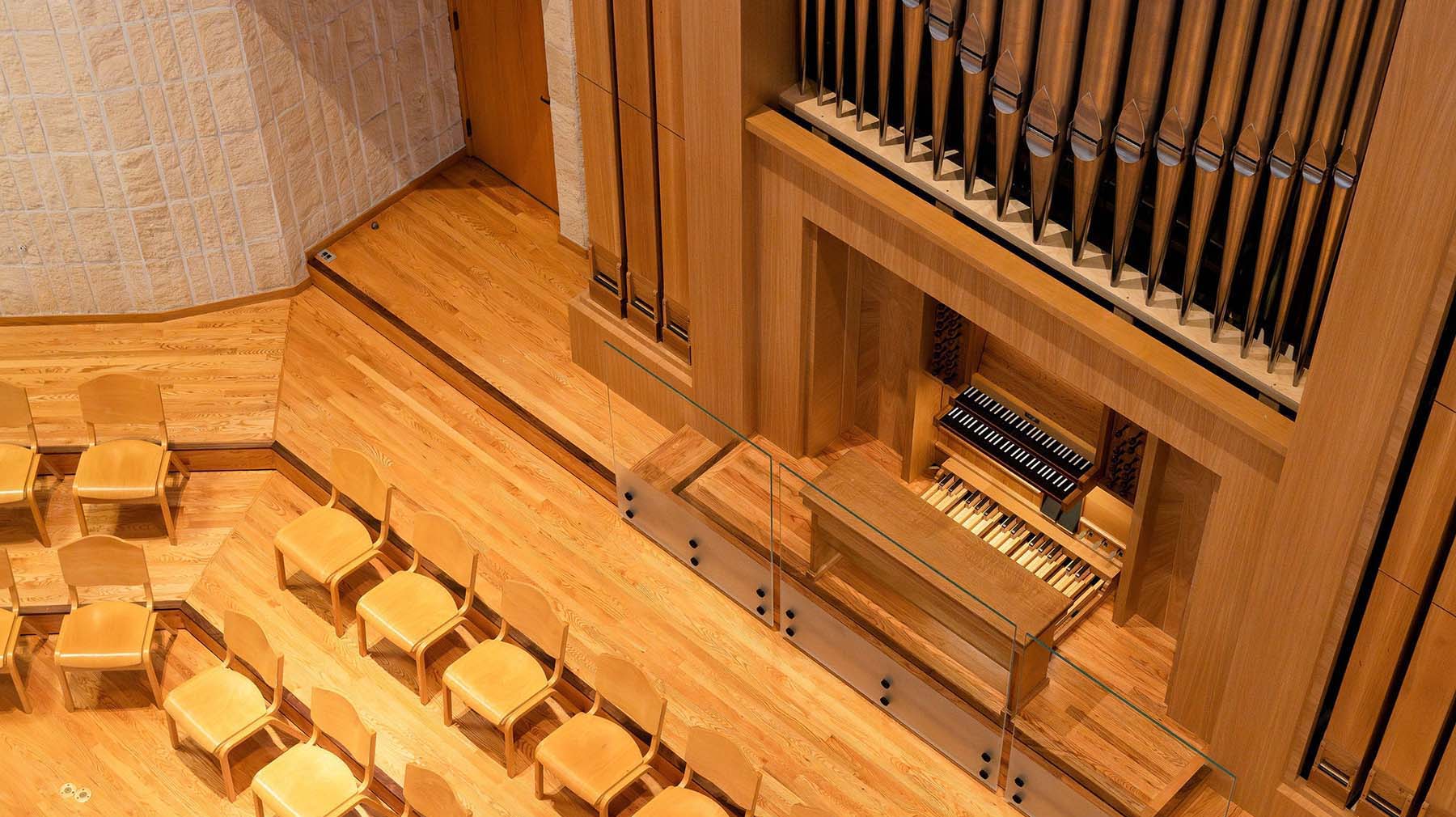
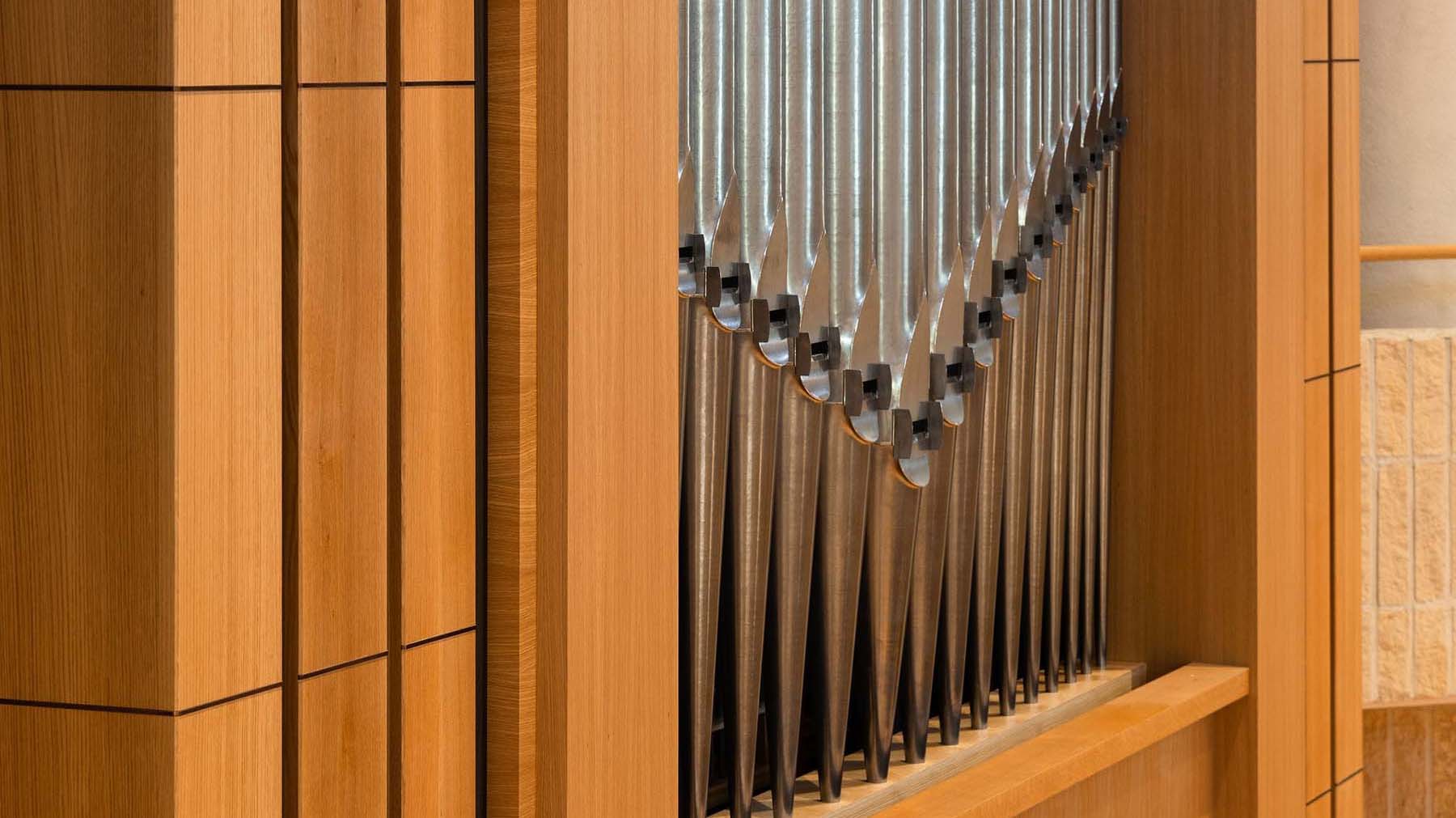
DW pipe organ project Fisk Op. 67a takes the spotlight in The American Organist, a globally respected magazine devoted to organ and choral music. Architect C.P. Drewett designed the award-winning modern casework that frames the Fisk Opus 67 pipe organ—now the centerpiece of Camelback Bible Church in Paradise Valley, AZ.


We are confronted with insurmountable opportunities. — Walt Kelly
Story by David C. Pike
Makers of fine pipe organs realize that their company has been around for a while when they start receiving calls for work of a previous generation to be restored or, heaven forbid, removed and relocated. Such was the case with C.B. Fisk Opus 67, installed at Central Christian Church, Huntington, Indiana, in the summer of 1976. Four years prior, the organ had been commissioned to serve as the centerpiece of the sanctuary in a brand-new church building. Chief architect Jack Pecsok of the Indianapolis firm Pecsok, Jelliffe & Randall spent many hours consulting with Charles Fisk to ensure that the organ’s visual design would engage seamlessly with his architectural concept. And it did. The organ case, with its simple, clean lines and tall, angled side panels that keyed into a V-shaped notch in the ceiling, meshed niftily with the church’s interior. The instrument looked like it was part of the room and would never be removed.
It was also one of the first organs that Charles Fisk designed and voiced after his 1974 research trip to East Germany. During this seminal expedition behind the Iron Curtain, his organ-building vision expanded irrevocably, thanks to the sounds of the Gottfried Silbermann instruments he heard and documented.
Because of these factors, while it was not built for a particularly large or reverberant space (Central Christian was, if anything, compact and, in the end, carpeted wall to wall), Opus 67 was an important instrument for the then 15-year-old organbuilding firm. In 1985, nine years after the organ’s inauguration, three stops that had been prepared for were added, marking the completion, by his successors, of Fisk’s original tonal design.
Decades passed. And then, four years ago, we were contacted out of the blue by the church’s leadership. The message was brief, absolutely unanticipated, and downright disappointing: they wanted the organ removed. It had stood silent for years, they said; it was neither needed nor wanted, inasmuch as their musicmaking had undergone a major shift in emphasis. Plus, they needed the space. Not surprisingly, a cavalcade of questions followed. How should they proceed? Could we help them locate a potential buyer for Opus 67? How much could they reasonably expect to get for the instrument? How and where should they advertise in order to best conjure interest? Could we remove the instrument as soon as would be convenient for us once a buyer had been found?
To cut a long story short, much to our surprise, an enthusiastic buyer was indeed found in early 2022, and the improbable story of Opus 67’s resurrection was set in motion. For over 40 years, the people of Camelback Bible Church in Paradise Valley, Arizona, had been searching for just the right pipe organ to grace their splendid, much-loved worship space and to provide an anchor for their vibrant music program. Numerous proposals had been put forward over the years, but cost had always been a deterrent, obliging the church to opt for an electronic. Organist Guy Whatley expressed delight in being given the opportunity to acquire a top-quality tracker instrument-one, moreover, that had been voiced by Charles Fisk nearly 50 years prior.
Camelback’s minister of music and worship in the I 980s and ’90s, Rev. Dr. George Dupere, oversaw the development of the church’s first-rate music program. Dupere also masterminded the layout and construction of the church sanctuary. He hired Larry Kirkegaard to design the acoustics from the ground up, resulting in one of the finest acoustical environments for musical performance in the greater Phoenix area. Choral ensembles in particular continue to seek out Camelback Bible Church as both a performance and a recording venue. Kirkegaard’s son Dana, who was involved with the project from its inception and therefore knew the sanctuary acoustics intimately, served as consultant during the preparation of the building to receive the Fisk.
Opus 67 had found a sympathetic new home. However, there were two significant issues to be addressed. First, the case design, as fitting as it was for Central Christian, was not at all relevant to Camelback; second, the organ’s tonal disposition required careful consideration, as its new home was far more voluminous and reverberant than its original setting.
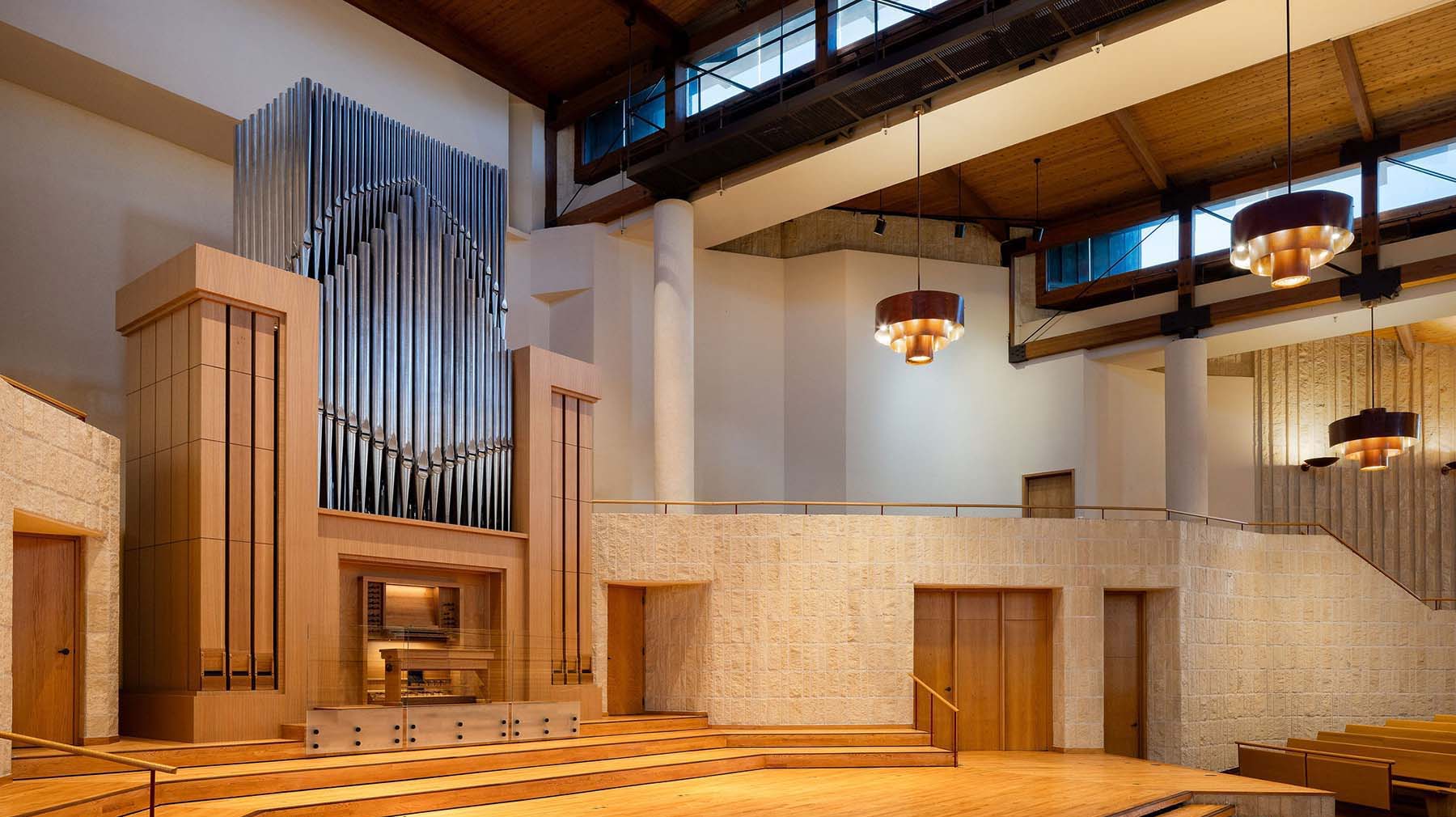
Vis-a-vis visual design, enter C.P. Drewett, president and founding architect of Drewett Works, a Scottsdale architecture firm specializing in high-end residential and commercial buildings. Longtime members of Camelback Bible Church, Drewett and his family have sung in the choir for years, and his wife, Elizabeth, was recently appointed director of classical worship. Working closely with Fisk personnel and acoustician Dana Kirkegaard, Drewett devised a unique and fresh case design that expertly fuses the traditional with the modern, honors the organ’s interior layout, and at the same time rightly complements the sanctuary architecture. Drewett explains: “While traditional organ cases are often ornate, this one is dean and modern, so as not to overwhelm the sanctuary’s design. Cut from oak, the case consists of three components representing the Trinity: the Father, Son, and Holy Spirit:’ All of the visible casework was veneered, using oak from a single tree, by Linear Fine Woodworking, a custom architectural millwork firm in Phoenix that regularly partners with Drewett Works.
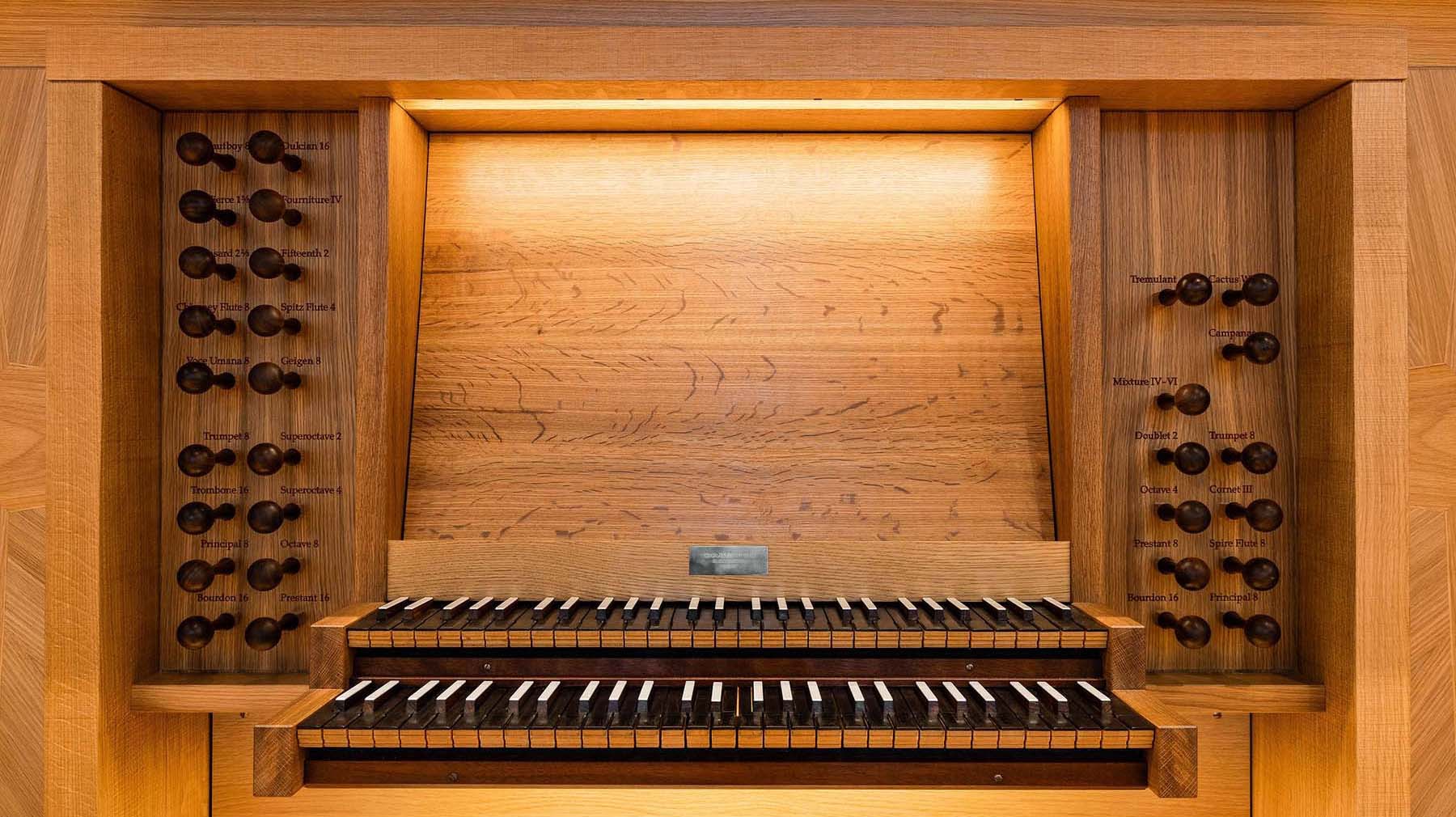
With regard to its sound, Opus 67 has breathed a palpable sigh of relief in its new home. One can easily imagine the satisfaction and joy that Charles Fisk would feel could he experience this organ today. But there are alterations to the original stoplist and mechanicals that he wouldn’t recognize. To the Great was added a second 8′ open to complement and enhance the original spotted-metal Principal; the new stop, called Prestant, is made of hammered lead and stands in the facade. The Swell, with its new full-height enclosure and independent rear shades, gave up its feisty 8′ Cremona but gained a gentler, more broadly useful 16′ Dulcian. The Swell is also now home to an 8′ Voce Umana, giving the instrument a much-appreciated undulant. The Pedal division was the beneficiary of a 16′ Prestant, extended from the existing 8′ Octave. The six largest pipes are made of solid quartered oak and, fronting the Pedal towers, offer a gratifying tonal-and commanding visual-impression. The rank continues in hammered lead, with facade pipes positioned at impost level. The original spotted-metal facade 8′ basses now stand in the Pedal as a secondary 8′ Principal. Finally, the former half-length cylindrical Pedal 16′ Bassoon was replaced by a full-length 16′ Trombone with 8′ Trumpet extension. These two new full-length 16′ voices add a welcome gravitas to the organ’s sonority. Minus the Pedal Bassoon and Swell Cremona, all original Huntington pipework remains.
Likewise, the Great and Swell windchests, along with their rollerboards, were retained. Due to the extensive modifications to the Pedal division, new chests and rollerboards were constructed. The console, formerly detached, is now attached to the lower case. The Huntington keyboards, showing very little wear, were kept. The console surround, including the music rack and the drawknobs, is altogether new. All trackers, initially made of 2mm aluminum wire, were replaced with carbon fiber. The stop action remains mechanical but has been rebuilt in its entirety.
Remarkably, there are three people still at the Fisk workshop who were part of the team that originally built Opus 67. Robert Cornell, Stephen Paul Kowalyshyn, and Linda Cook all participated in the organ’s first creation, and now, 48 years later, in its transformation and relocation.
For the inauguration of Opus 67 in October 1976, Charles Fisk wrote the following:
In building this organ we have endeavored to provide for the direct musical needs of this church. At the same time we have tried to make possible music from epochs other than our own. The world of church music spans centuries; this organ, despite its contemporary appearance, reaches far back into the musical past for its inspiration. Perhaps our most enduring purpose is to show how full of life the best church music has always been.
Project Details//Fisk Opus 67
Location: Paradise Valley, Ariz.
Architecture: Drewett Works
Millwork: Linear Fine Woodworking
Organ restoration: C.B. Fisk Inc.