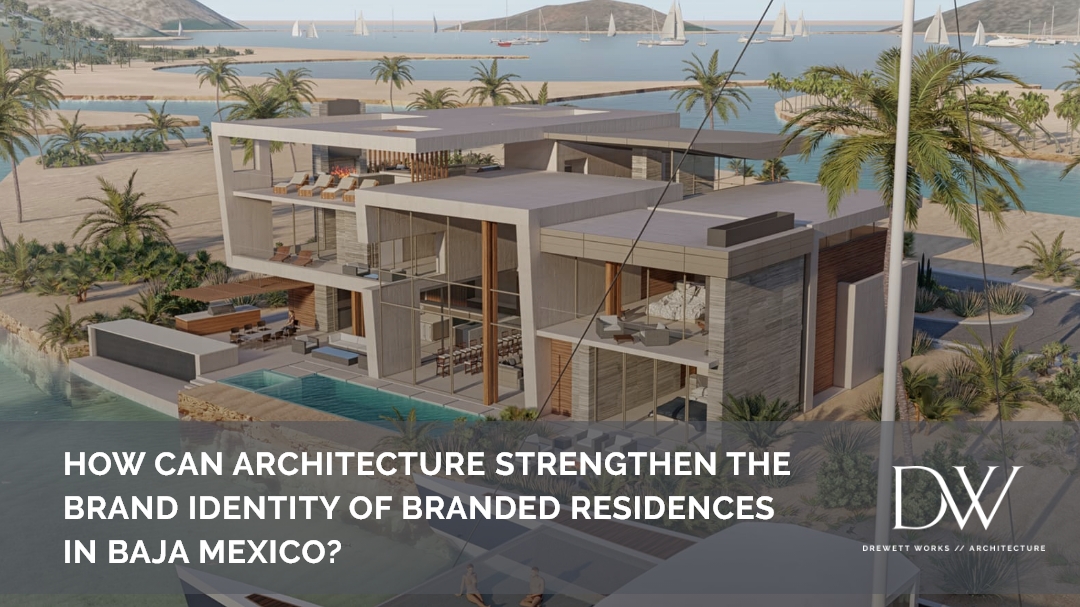
Architecture can strengthen the brand identity of branded residences in Baja Mexico by translating a brand’s positioning into a physical experience that is also distinctly connected to its location. From private residences and arrival sequences to clubhouses, amenities, landscape, and material selections, architecture can create a recognizable identity while responding authentically to Baja’s distinctive combination of desert, mountains, coastline, and outdoor living.
For developers, that balance is increasingly important. As luxury residential and hospitality development continues throughout destinations such as Los Cabos and other areas of the Baja Peninsula, a respected brand name and an extensive amenity program may attract attention, but the experience of the development ultimately needs to deliver on that positioning.
Architecture is one of the most enduring ways to do it.
Translate the Brand Into an Architectural Experience
A luxury brand is defined by more than a logo, visual identity, or level of service. It represents a set of expectations.
Those expectations might center on privacy, understated luxury, wellness, adventure, exclusivity, connection to nature, or highly personalized experiences. Architecture gives developers an opportunity to translate those qualities into something residents can experience every day.
The scale of the residences, approach to materials, relationship between indoor and outdoor spaces, degree of privacy, arrival experience, and design of shared amenities can all reinforce the development’s positioning.
This allows architecture to communicate the brand without relying on overt branding.
For branded residences in Baja, the strongest architectural identity can emerge when those brand values are interpreted through the destination rather than simply applied to it.
Make Baja Part of the Brand Identity
One of the greatest assets available to a branded residential development in Baja Mexico is Baja itself.
The region offers a dramatic architectural context shaped by desert terrain, mountains, coastline, intense natural light, ocean views, and a climate that encourages outdoor living.
Architecture can make those qualities integral to the residential experience.
Site orientation can prioritize significant views. Courtyards and shaded terraces can provide comfortable outdoor spaces. Materials can establish a visual relationship with the surrounding landscape. Pools, gardens, walls, pathways, and buildings can be considered together rather than as separate elements.
These decisions help create an identity that belongs to the location.
For a luxury brand with properties in multiple destinations, that can be particularly valuable. The Baja development can feel unmistakably connected to the broader brand while offering an experience residents could not have somewhere else.
Balance Brand Consistency With a Sense of Place
Branded residences often require designers to navigate two potentially competing objectives: maintaining the standards and identity associated with the brand while creating architecture specific to the destination.
Consistency matters, but consistency does not necessarily mean replication.
A brand’s underlying design principles can be interpreted differently in Baja than they would be in an alpine, urban, or tropical setting.
For example, a brand centered on privacy and connection to nature might express those values in Baja through protected courtyards, carefully framed views, natural materials, landscape integration, and residences that sit quietly within the terrain.
The identity remains consistent even though the architectural expression changes.
This approach can help prevent branded developments from feeling formulaic while preserving the qualities residents associate with the brand.
Create Cohesion Without Making Every Residence the Same
Luxury residential buyers typically expect individuality. A branded residential community, however, also needs to feel cohesive.
The solution does not have to be architectural repetition.
Instead, developers can establish a shared design language that provides a framework for individual residences.
Material palettes, proportions, landscape principles, roof forms, shading strategies, architectural detailing, and approaches to indoor-outdoor living can create visual continuity across a community.
Within that framework, individual residences can respond to differences in topography, orientation, views, privacy, and program.
This becomes particularly important in larger or phased developments where multiple residences may be designed and built over several years. A clear architectural vision can preserve the identity of the community while allowing it to evolve.
Use Indoor-Outdoor Living as a Defining Experience
In Baja Mexico, indoor-outdoor living should be more than a feature added to a luxury residence.
It can become part of the architectural identity of the entire development.
Covered terraces, courtyards, outdoor dining spaces, pools, gardens, breezeways, fire features, and shaded gathering areas can extend the residential experience into the landscape.
Architecture can also choreograph how residents move between these environments.
An interior living space might transition into a protected outdoor room before opening toward an expansive ocean view. A private courtyard might provide a quieter counterpoint to a dramatic coastal terrace. Walls and landscape can create privacy without completely separating the residence from its surroundings.
When these ideas are carried thoughtfully throughout a branded community, the relationship between architecture and the Baja environment can become one of the experiences residents associate most strongly with the brand.
Let Amenities Reinforce the Brand
Amenities are an important component of many branded residential developments, but their value extends beyond the number of features offered.
The more strategic question is: Which experiences should define life within this particular community?
For a Baja development, the answer might include wellness, golf, dining, outdoor recreation, social connection, privacy, or access to the water.
Architecture can reinforce those priorities through the placement and design of clubhouses, beach clubs, wellness facilities, restaurants, pools, fitness spaces, and gathering areas.
A wellness pavilion might occupy a quieter part of the property overlooking the desert. A beach club can strengthen the community’s relationship with the coastline. A clubhouse might become the social center of the development, positioned around views and designed to transition naturally between indoor and outdoor gathering spaces.
When amenity architecture supports the development’s positioning, those spaces become tangible expressions of the brand.
Consider the Entire Resident Journey
Brand identity is experienced across the entire property, not only within the residences.
The sequence begins with the approach to the development and continues through the entry, landscape, roadways, clubhouse, amenities, pathways, and individual residential arrival.
Each moment offers an opportunity to reinforce the character of the community.
In Baja, topography and views can make this particularly powerful. Rather than revealing the entire property at once, architecture and landscape can create a progression of experiences—moments of enclosure followed by expansive views, transitions between desert and cultivated landscape, or gradual visual connections to the water.
These experiences may be subtle, but collectively they influence how residents perceive and remember the development.
Establish Architectural Identity During Master Planning
For larger branded residential communities, architectural identity should ideally begin at the master-planning stage.
Long before finishes or individual residential details are selected, decisions are being made that will shape the experience of the development.
Where are residences positioned? How are views protected? Where do residents naturally gather? How are amenities connected to residential areas? How does the development transition from public to private spaces? How do buildings respond to the terrain?
These decisions can have as much influence on brand identity as the architecture of an individual residence.
Establishing a strong design framework early can also help maintain consistency as a development moves through multiple phases or involves different project teams.
Avoid a Luxury Development That Could Be Anywhere
The luxury residential market is filled with exceptional materials, expansive glazing, infinity pools, wellness amenities, and dramatic views.
Those elements alone do not necessarily create identity.
For developers of branded residences in Baja Mexico, a more meaningful question is:
What about this development could only happen here?
Perhaps it is the way residences settle into desert terrain. The relationship between a clubhouse and the Sea of Cortez. The sequence from a shaded courtyard to an expansive ocean terrace. The use of materials that visually connect buildings to the surrounding landscape.
Architecture that responds to those opportunities can help a branded development move beyond a recognizable aesthetic and create a true sense of place.
That distinction becomes particularly important as Baja’s luxury residential market continues to evolve.
Creating Branded Residences That Belong to Baja Mexico
The strongest branded residences can achieve two objectives simultaneously: they feel unmistakably connected to the brand and unmistakably connected to their destination.
In Baja Mexico, architecture provides the bridge between the two.
By integrating residential design, amenities, landscape, master planning, and the natural environment into a cohesive architectural vision, developers can create communities that express the values of the brand while delivering an experience specific to Baja.
Ultimately, successful architectural branding is not simply about what a development looks like.
It is about creating a place residents recognize, remember, and associate with the experience the brand promises.
Establish a Distinctive Architectural Vision in Baja Mexico
Drewett Works approaches branded residences and luxury hospitality architecture with an emphasis on elegant, modern, organic design shaped by place. For developers planning branded residential communities and luxury destinations in Baja Mexico, our team can help establish an architectural vision that connects residences, amenities, landscape, and experience while responding authentically to the character of the site.
Contact Drewett Works to discuss your vision for a branded residential development in Baja Mexico.